Dr. Adhikari Urges Government to Act on Seismic Science
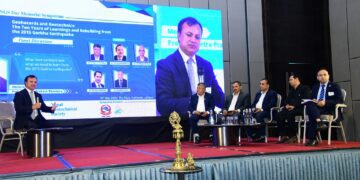
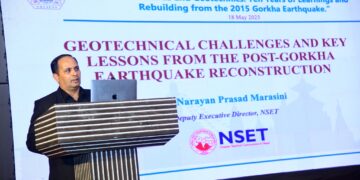
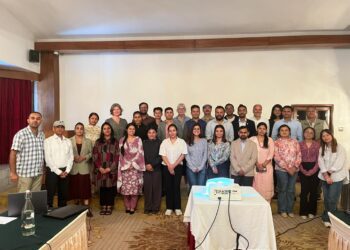
Kathmandu, Baisakh 5 – In a striking presentation during the 31st anniversary symposium of the Nepal Geotechnical Society (NGS), senior seismologist Dr. Lok Bijay Adhikari warned that Nepal’s seismic threat is far from over, even a decade after the devastating 2015 Gorkha earthquake.
Presenting on the theme “Learning from Seismicity: After 10 Years of Gorkha Earthquake,” Dr. Adhikari reminded participants that the 7.6 ML (7.9 Mw) Gorkha Earthquake, which shook the nation for 50 seconds and resulted in over 9,000 deaths and 22,000 injuries, was just part of a larger seismic puzzle.
“People think the danger is over—but in fact, seismic activity has doubled compared to pre-2015 rates,” Dr. Adhikari emphasized.
⚠️ Why Did the Earthquake Not Extend Beyond Gorkha and Dolakha?
According to Dr. Adhikari, the rupture from the Gorkha quake spanned from Gorkha to Dolakha, but did not break westward or far eastward due to the fault’s zig-zag, non-linear pattern. The quake seemed to follow Nepal’s topography “like flowing along a map,” deviating instead of striking in a straight line.
📊 Seismic Activity Snapshot:
Over 3,000 earthquakes occur annually in Nepal.
Post-Gorkha, the country has recorded more than 45,000 aftershocks.
Interseismic activity is currently concentrated in western Nepal, whereas post-seismic aftershocks continue in the east.
In Himalchuli (2017–2020), an unusual seismic swarm occurred—over 1,000 micro-earthquakes (<2.3 ML) recorded in a single day, repeating in 3-month intervals over 3 years. Dr. Adhikari termed this a “puzzle event.”
🌍 Lamjung Earthquake 2021: A Warning Sign?
Dr. Adhikari also discussed the 2021 Lamjung earthquake, which occurred 30 km west of the Gorkha quake’s epicenter, in a similar structural setting. Its location lies at the edge of the 2015 afterslip zone, hinting at ongoing stress accumulation.
“This could be a red flag. We must monitor the western seismic cluster closely,” he noted.
🔍 Science vs. Policy: A Disconnect
In his closing remarks, Dr. Adhikari raised concerns about the lack of attention to seismic science in Nepal’s governance and disaster planning.
“Scientific data is available, but seismic science is often ignored. It’s not that we lack knowledge—it’s that authorities fail to act,” he cautioned.
🧭 Call to Action
The seismologist called for improved integration of earthquake science with policy, and warned that ignoring micro-events and swarms may lead to bigger surprises in the future.
“Gorkha was not the end—it was just one part of a bigger story still unfolding.”
Raju Jhallu Prassad, who is also recognized as Rajendra Bhatta, has thrived in the field of journalism for seven fruitful years. Currently, he holds the position of Chief Editor at Tourshala, focusing his expertise on Environmental Journalism. His wide-ranging interests encompass History, Culture, Tourism, Theatre, and Literature. Beyond his journalism career, Raju is a dedicated researcher, an enthusiastic traveler, a prolific writer, and a passionate student of theater.
You can get in touch with him at raju.tourshala@gmail.com or jhalludurbar@gmail.com.






























Discussion about this post